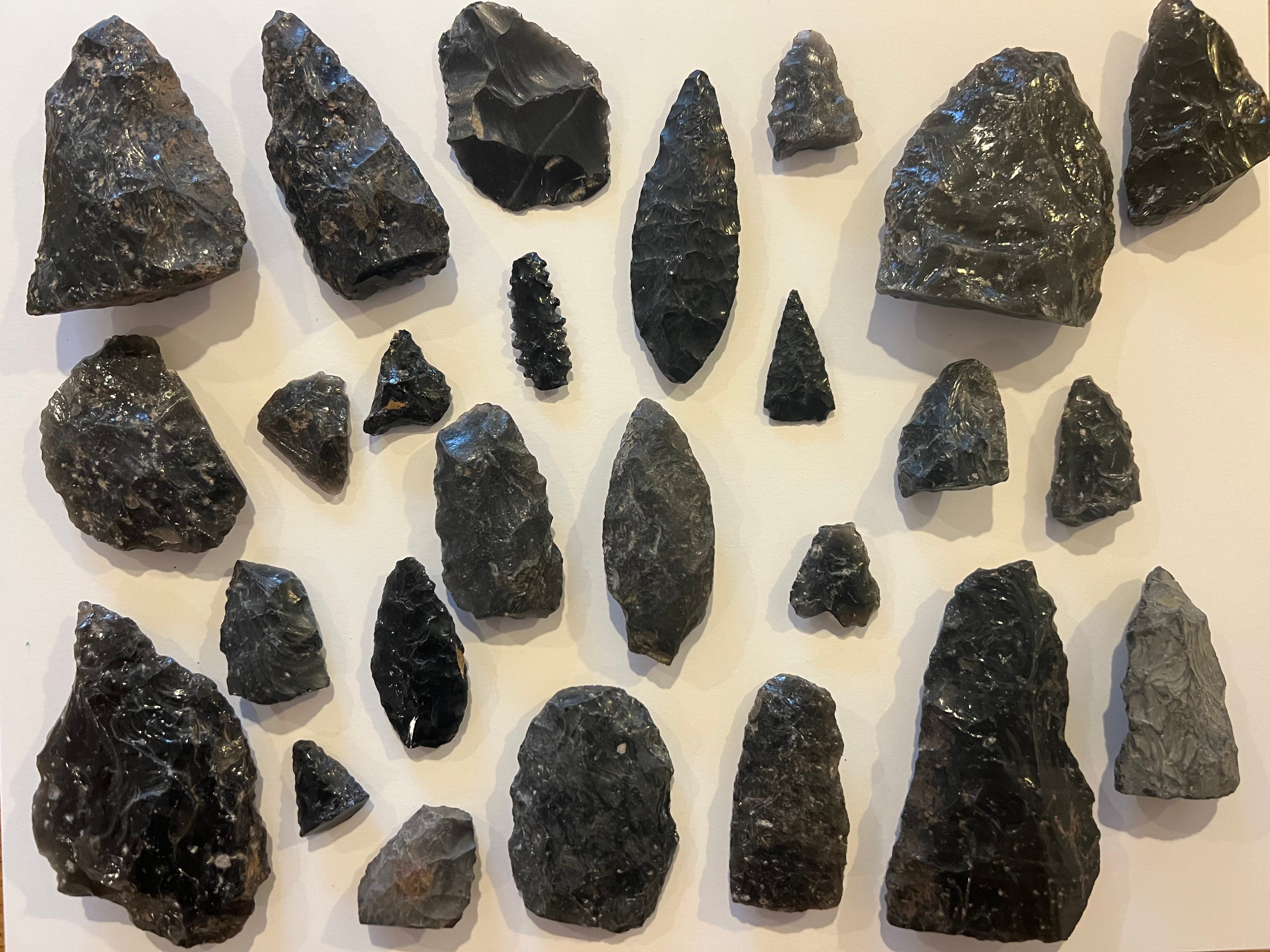
Artifact
An essay on finding things and losing others

For years my grandparents lived in a redwood-skirted doublewide on Cobb Mountain, a rolling foothill of Mt. Konocti, one of California’s ancient volcanos. Gramps always said that Konocti, whose Pomo name means “woman mountain,” was extinct. He died believing this was true. It is not.
Though Konocti hasn’t erupted for more than 10,000 years, its abundance of hot springs, gas seeps, and an occasional volcanic earthquake prove just how alive it is. The USGS, in fact, classifies Grandpa’s mountain as having, a high threat potential. My grandparents, however, spent more time worrying about forest fires than lava. Or about wildcats eating Bummer, their one-eyed orange tabby with a front leg limp who had a penchant for picking inter-species fights.
I was just a kid when my grandparents bought their 1-acre parcel. Wasn’t long before they laid a foundation for what would eventually be their retirement home. But until then it was their regular getaway from the bustle of south San Francisco, and a family gathering spot for the rest of us. “Going to the country,” meant going to Gram and Gramps’ house in the woods.
Gram filled the yard with garden trinkets that caught sun and made a bunch of racket, while Gramps painted blue ribbon winning naturescapes for the State Fair. There wasn’t much for us kids to do in the country besides pick from Grams’s endless trays of snacks—pepper jack cheese and sweet pickles, usually—and hope that my cool uncle who raced Hobiecats in Mexico might make an appearance. He rarely did.
Didn’t take long for the novelty of this place in the woods to wane. Eventually I brought my own entertainment for weekend stays—books and games, mostly. But I also started lugging along a pad of drawing paper and colored pencils because I wanted Gramps to see how much I liked art.
On one visit, Gramps unexpectedly arranged for me and my dad to join him and his buddy on the opposite slope of Konocti. His friend had just bought some property, and while surveying the land came across a few busted arrowheads and shards of clay pots. He wanted to dig up as many as possible before the contractors were forced to pause construction and call in the archaeologists. Gramps’ penchant for local history got him an invitation to this secret looting session, and he was all in.
It now seems a little surprising that Gramps included me and my dad in the outing. I was still pretty young and kids weren’t really his bag. Plus, I was generally terrified of adults. But Gramps was fired up by the adventure of it all. Shared it with us, I assume, because he just couldn’t contain himself.
We loaded up in the cab of his truck—which still smelled of rotten fish from when a fresh catch slipped under the seat and went undiscovered for a few months. Then we slowly jerked along washboard backroads to the opposite side of the mountain.
It was a windows down sort of day. A quick and quiet trip. Gramps’ pal waved towards a clearing as he covered his face with a red handkerchief. Gramps cut the engine and mashed the e-brake. My dad got out of the truck and told us to watch our step. The ground was steep, and I had to lean uphill to find my balance. Gramps’s buddy peered at us like he didn’t know we’d be in tow, but still he wasted no time telling us what to look for.
“The ones I found up there were yay-big and all black. Kinda like like shiny charcoal,” he said.
I wandered around, gazing at the earth until my neck hurt. All I saw on the ground were little rivulets. I imagined rolling my Hot Wheels through these mini-canyons. Hide plastic army men in the berms, hold out for an ambush. It probably seemed like I was diligently looking for the black rocks that made Gramps so excited, but I wasn’t. I was lost in my own imagination.
The hillside was covered in a layer of scrub. A few jutting manzanitas put off a whisper of shade. Barely ten minutes in I needed a break. If it was just my dad and me, maybe even if it was just Gramps and me, I’d have made it clear that I was done. Looking for rocks was boring. And all I could think about was sitting at Gram’s counter eating more snacks. But I couldn’t show my true colors with Gramps’ buddy around. Didn’t want him to see me as anything but one of the guys. At some point Gramps caught me sitting in the dirt, staring at the sky.
“Just keep on looking!” he hollered—his hands like a megaphone.
He gave a thumbs up, and I gave one back. Which reminded me to get back to staring at the ground. Went on like this for an hour or so. Soon I came upon a dark grey triangle dotted with flecks of dry mud. It was warm on the sunny side. Its edges razor sharp.
“Hey! I think I got one,” I screamed to the guys.
Gramps looked over and raised his arms like Joe Montana. Now that I knew what I was looking for, I suddenly saw similar pieces everywhere. I lowered to my hands and knees, and flicked more bits of sharp stone from the earth. I filled my pockets. Eventually Gramps came over to see how I was doing. I showed him what I had collected.
“Woah son! You got some good ones there!” he said. “That there’s obsidian. It’s volcanic glass. Fast drying lava from this volcano you’re standing on.”
He pointed to the top of Konocti. I’d never heard that word before—obsidian. My lips repeated it over and over. Obsidian, obsidian. What a beautiful word, I thought. It sounded big. Felt big. But also cool and sharp. It sounded like a secret.
Gramps’ buddy’s land was littered with discarded stone tools from aeons past. We hunted until I wished I had a sweatshirt. I went back to Gramps’ place with more than a hundred bits and pieces. Spent the rest of the evening cleaning them under the dim patio light with a bucket of warm water and dish soap. The next day I found a few similar stones in Gramps’ yard. Which gave me new reason to get excited to go to the country.
In the decades since I’ve found thousands of artifacts all over the world. I got my degree in anthropology and worked as an archaeologist for a few years which, by the way, was nothing like Indiana Jones made it out to be.
I often joke that if there’s anything to be found, I’ll find it. Friends have called me out on this claim until I place a gorgeous stone tool in their hand. And when I do, their eyes reflect the same look I must have had while hunting with Gramps that day.
“Keep it if you want to,” I’ll usually say. And they usually do.
Artifacts offer an immediate and material connection to an invisible past. It’s proof that the world exists beyond me. Hearing a distant train whistle does the same thing. Another clue to assure me that life exists outside of my own little world. That it’s not all about me.
Years later, around the same time Gramps’ memory began seeping away, he and I sat talking on a swinging bench in his yard. He told me all those arrowheads were planted for me to find. He said they were fakes. His goal had been to create a moment of inspiration. And apparently, according to him, my dad was in on it, too.
I bit my tongue, certain that Gramps’ budding Alzheimer’s was compromising the narrative. But he kept on, and in more detail. The more he rambled, laughing at his recollection of my starstruck face, the more I felt compelled to interject. I knew this news was untrue, but still I grew defensive. And the more he kept at it, the more I needed him to know he was wrong.
I was certain his account was erroneous. I had studied obsidian points and knew the difference between a side-notch and a straight stem. A bi-face Clovis and a Cumberland. Mine from our day on Konocti were undoubtedly real. They were, most likely, Pomo relics, dating back at least 500 years, possibly thousands. I literally dug them out of the ground. Gramps planting that many fakes would have been impossible. He was crafty, but he wouldn’t have spent the time to bury hundreds of reproductions just so his knucklehead grandson could have a wow moment. No way.
To be fair, there was a time when he did pull an arrowhead switcheroo, but it happened years later, and it didn’t include me. Gramps hid a perfect souvenir shop spear point under a green coiled hose near the car port in his front yard, then he sent my little brother out to look for “Indian heads” as he called them.
“You know, just like your big brother used to do,” Gramps said.
My brother obliged and followed the old man’s giggling directions to where the best ones always show up after a good rain.
“Look over there,” Gramps hollered from the porch. “Or maybe over there.” My brother played along until he found the fake thing right where Gramps had planted it.
“Well now, wouldya look at that!” Gramps said, clapping in my brother’s direction. “Everyone come see what the boy just found!”
A curling photo commemorates the moment—Gramps stands behind my baby brother, the unassuming sucker, who proudly holds up a black and magnificent glassy triangle like some kind of trophy.
This moment became one of those told and retold stories. And it wasn’t until years later, when it came up again at a family gathering, that my brother learned he’d been bamboozled. All this time he’d kept that perfect point on display at home. After learning it was a fraud, he smashed it on his back patio with a hammer, then swept the razor sharp pieces into a dustbin before throwing it in the trash. One detail can change a lifelong narrative.
When I couldn’t take any more of Gramps’ broken memory, I flat out told him he was wrong. That he was mixing up two separate events that happened years apart, and with two separate grandsons.
“The ones I found were real!” I barked.
My tone was crass and needy. I wanted him to know that I knew better. I highlighted my untarnished recall, which drew pointed attention to my grandpa’s crumbling faculties. I didn’t care if I hurt his feelings. I wanted to be right. And I wanted him to know I was right.
Rather than hold his ground like he always did, this proud man, a man who stood tall even when he was wrong, let go. His joy from reminiscing disappeared. He looked down and shook his head. Rubbed his liver-spotted hands atop his faded blue Wranglers. Took a big breath.
“Goddammit,” he whispered, looking up at me. “I’m sorry, son. Really sorry. I guess I don’t remember, you know?”
Which only made me wish I had kept my big mouth shut.
I spent that afternoon wandering around Gramps’ yard, picking up pieces of new black glass uncovered by summer storms. I held thin ones up to the midday sun, noticed how the light broke through its fractures. I scrutinized the pintip bubbles embedded in the hardened lava. When my back started hurting from stooping, I went inside. Gramps sat in a recliner watching Judge Judy on full blast. Three plates of snacks sat on an adjacent counter, each platter covered by a wisp of cellophane. Gramps sat up quickly.
“You find anything?” he shouted over the television.
“Yep. One nice one and a couple busted up ones,” I said. “The usual.”
Gramps hit mute on the remote and shifted his attention towards me. I handed him my finds. He rubbed each one between his fingers. Picked out the shapely one. Nodded his head.
“You know,” he said, “all these years I’ve never found any in the yard.”
But that wasn’t true. Just across the room he had a shelf filled with arrowheads he dug up while building a tool shed years ago. Others from when he broke ground for the driveway Gram wanted after the summer dust made a mess of the yard.
“Boy oh boy, this one here’s a beaut,” he said, shifting his body to hold the choice point under a lamp. “Wow. Would ya look at that.”
“Yeah. That’s a lucky find right there,” I said.
“It sure is fine,” he said. “A real doozy.”
“Why don’t you keep it, Gramps?” I said. “It’s from your yard, after all.”
Gramps looked up at me. Eyes bigger than his glasses.
“Yeah, man. Go on, keep it,” I said, “I’ve got a bunch already.”
“Well pil-grim,” Gramps said in his John Wayne alter-ego that always appeared in emotional moments, “if you in-sist.”
He handed me the broken pieces then lifted up his waist to put the arrowhead in his pocket.
“Gon-na stash it right here for safe keep-ing,” John Wayne said, tapping his hip.
He turned back to the TV, grabbed the remote, unmuted the tube, and cranked up the volume a few bars.
“Go get you some snacks, now,” Gramps yelled, motioning his hand towards the kitchen. “Your Grandma put them out special just for you.”
As I sat on a barstool, Gram finished whatever she was doing in the bedroom, folding laundry perhaps, then took a seat across from me.
“You want more pickles?” she asked.
“No thanks, Gram, I’m good,” I said.
“How about a sandwich?” she said. “I could make you a sandwich?”
She got up and shuffled towards the fridge.
“No Gram, really, thanks. I think these snacks will be enough for now,” I said. “I’m all set.”
She pulled out a few packs of lunchmeat, held them at arm’s length, examined the labels.
“Looks like I’ve got salami, or, I think it’s bologna? Yes, bologna,” she said.
“The boy said he don’t want anything!” Gramps yelled over the TV. “Didn’t you hear him for God-SAKES!”
Gram laughed. Returned to her seat and folded her hands on the counter. Quietly told me to let her know when I wanted a sandwich. Our attention went to the loud screen. I got immediately reeled into the courtroom drama, then shifted my attention to my phone. I texted my little brother.
I wrote: Hey man. At G&G’s and thinking of you. Gramps thinks I’m the one with the fake arrowhead. Haha. His memory is fading. Loving Judge Judy.
He responded: Hey! Yeah, mom told me about his health. Sucks. I lost that arrowhead in a move. Always knew it was a fake. Judge Judy! Ugh!
I read my brother’s message and dropped back in my chair, which made a sound like I fell into it. Gram reached out and put her knobby hand on my arm.
“Everything OK?” she asked.
“Yeah Gram, I just realized I’ve been misremembering something,” I said.
“Oh, I’m used to that!” she said with a chuckle. “Happens to me all the time.”
Gramps again somehow heard our exchange over the roar of bad TV.
“Me too!” he shouted, raising his hand like he had the right answer.
I ate another pickle slice. A square of pepper jack. Gram asked if she can make me a sandwich.
“I’ve got salami and bologna. I can put some cheese on it if you want,” she said.
I paused before declining again. I couldn’t shake my version of my brother’s story. I’d been totally wrong all these years. He lost it in a move? What? How did I not know that? I thought he destroyed it on his patio. Where’d I get that story?
“Oh for God’s sake!” Gramps squawked again, making us both jump. “Will ya just make the kid a goddamn sandwich, already!”
Gram got up and shuffled over to the fridge, leaned in and pulled out the deli fixings again.
“I’ve got this bologna and salami…I think that’s what it is,” she said with a bag of lunchmeat in each hand. “You said you wanted salami, right? Pretty sure I also have turkey.”
Gram examined the packaging, flipping it over to see what it contained.
“Turkey! I’ll take a turkey one!” Gramps shouted. With mustard!”
“Oh, right. Yes. Look here. I’ve also got salami, Tommy,” my Gram said. “It’s fresh just yesterday. Remember when we used to call you Tommy Salami?”
Gram shook her head, quietly laughing at my old nickname.
“Nothing for me, Gram,” I said. “But thanks.”
“You were such a good boy,” she said.
“Jesus Christ!” Gramps hollered. “Just make him a sandwich and get on with it, will ya! Gonna be dinner before you get around to it.”
“Oh sorry.” Gram said. “Right…let’s see what we’ve got here.”
With his socked feet fidgeting as they rested on the recliner, Gramps looked at me and shrugged.
“See what I have to put up with!” he said. Then he grabbed the remote and cranked it up even more.
Gram rustled in the fridge again. Stooped down as she rustled the meats and cheeses. She pressed against her low back as she creaked upright, her hands full of lunch makings.
“Oh shoot,” she said. “I’m so sorry. For the life of me I can’t remember what you said you wanted. It was bologna, right?”