
The Ambulance Men
Trying to decipher what truths are necessary when speaking with someone who’ll forget it all anyhow

The intake nurse stood across from me and aside a steel gurney. She used her phone-like device to scan the left wristband of the man laying in front of her. The phone flashed a red laser and beeped. She gave its screen a confirming look, then greeted the patient cordially by name. She then introduced herself and told him she needed to ask him a few questions. “Is that OK with you?” she asked. His upbeat grunt was enough to get things started.
“What’s your name, sir?” I made out Kevin, but only because she had already said it. His last name, however, was indistinguishable. Just three distinct syllables ending with mashed consonants. Still, his ability to barely say his name, the one thing he’s known the longest, was enough for the nurse to say in a tone both robotic and patronizing, “Very good.”
She asked more questions. Kevin knew where he was. And thought the hospital would have been a sufficient response to, “Where are you right now?”, instead he said, “Strong Memorial Hospital.” His speech peppered with the efforts of a drunk person actively trying not to be noticed as one.
Kevin knew his date of birth, too. And the way he rattled it off—day, month, year—made me wonder if he was a veteran. Or a government employee. Or an immigrant. The tiniest details generally expose truths.
When the nurse asked Kevin what month it was, he paused. As his brain churned to find the correct answer, a stream of wet, bubbly air left his lips like an old engine turning over for the first time in a while. He stuttered out a rickety “J-, J-, J-“ as I telepathically corrected him. “No, Kevin. Not J. It’s D. December. Come on, man. December. December.” I squinted intently to expedite the mental transfer.
But Kevin stuck with J- and ultimately blurted, “June!” The nurse offered no affirmation this time, but quickly pivoted to ask what holiday we just had. “Christmas,” Kevin said. A no-brainer. She waited an extra second, giving Kevin a chance to perhaps change his previous answer about the month. But Kevin only smiled, awaiting her next question. The nurse repeated an affectless, “Good,” then asked, “Do you know why you are here, Kevin? Do you know what brought you to the hospital tonight?” Kevin said one word, “seizure,” which I heard correctly, but interpreted in an alternate meaning. Seizure, as in the action of capturing something using force.
I asked my mom the same sorts of questions at 2:00 a.m. a couple days ago when I finally made it to Strong after a last minute flight. “Do you know why you are here, mom?” I asked. “Well yeah,” she replied. Her annoyance opened a portal to my anxious childhood. “I’m here because the ambulance men brought me here,” she said. The ambulance men? I thought. I wanted to say, “EMTs, mom. You mean EMTs!” but I didn’t say anything.
I kept my eyes trained on her, awaiting some sort of elaboration. But she offered nothing. She didn’t mention having fallen for the third time this week. Or being dehydrated. Or the plethora of sugary treats she indulged in that tilted her glucose numbers and triggered a diabetic flare up. Neither did she note the 911 calls called on her behalf. Or her utter confusion. Or that she’d neglected to take her pills for five straight days.
She didn’t even mention the hallucinations she’d hit me with when I arrived before even saying hello. “Do I live with someone?” she breathlessly asked as I took off my coat. “Did someone bring over a bunch of small babies and place them all around my house?” She told me that it wasn’t until my dad appeared—His hair white as snow—that she started questioning reality. “Because he’s dead, you know?” she whispered. “I knew something was wrong when I saw him in my apartment.”
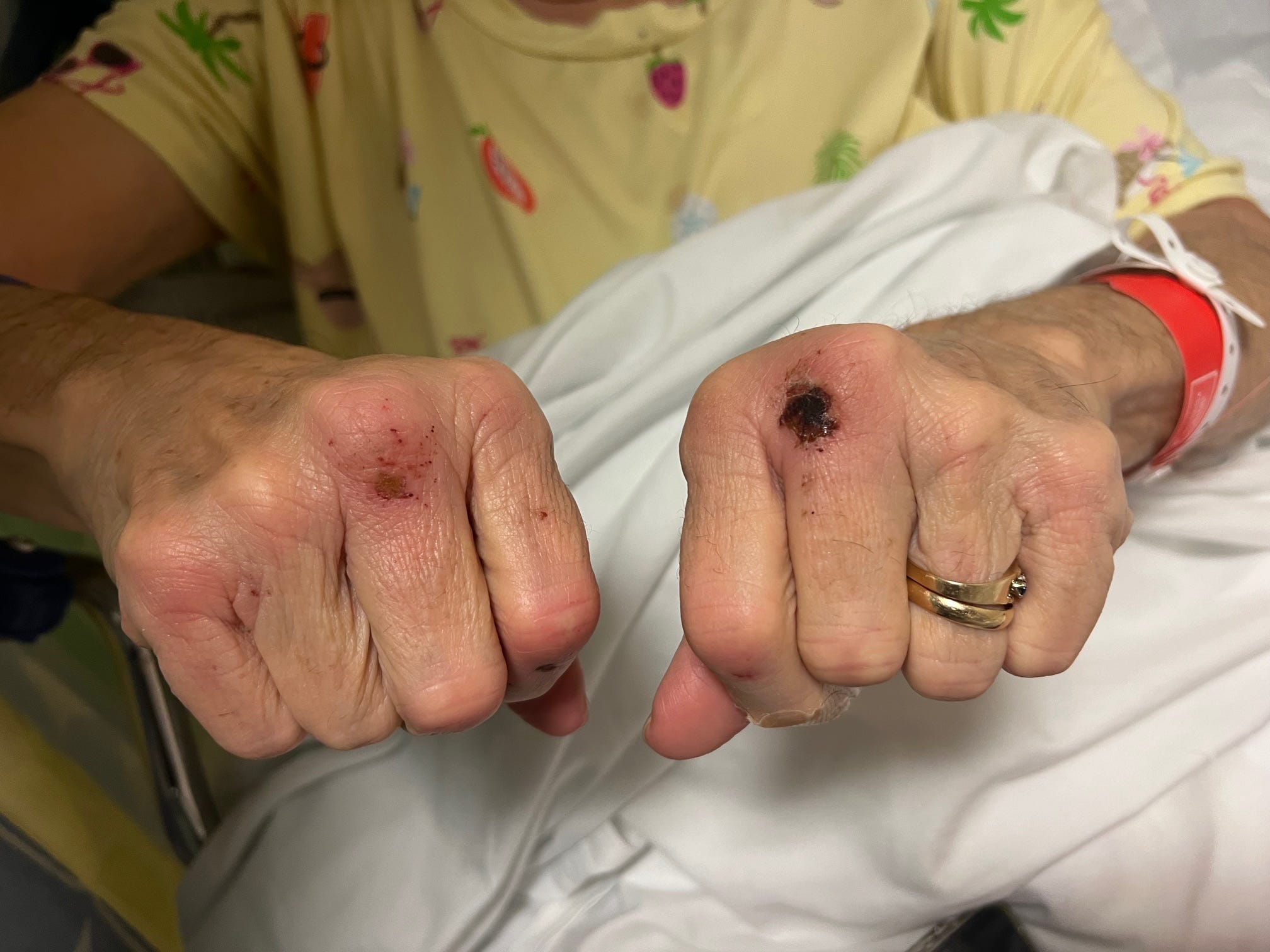
No. My mom mentioned none of the actual reasons for her most recent admittance to the emergency room. Instead, she remained stuck on the details of the ambulance ride. Yet in the midst of her misshapen narrative, her face lit up. She clasped her knotty hands together at her chest, which drew my attention to her scabby knuckles, now blood-blistered from struggling for unknown hours as she tried to hoist herself up off her apartment floor. She looked at me, wide-eyed, and said, “Oh, and let me tell you, Tom—those ambulance men were so nice to me! They were all so kind!” Knowing her, she probably made it a point to thank them for the ride.
My mom quit gushing about her EMTs when an old woman down the hall weakly bleated an elongated, “Heeeelp!” The ancient voice cackled a demonic spell, causing anyone within earshot to stop. The bustling wing hushed for a few startled seconds as we all absorbed her incantation. When nobody went to the lady’s aid, her clucking changed to a blood curdling squall, “Yoo-hoo…Yoooo-hooooo!” Her moans sent goosebumps down my arms and, at the same time, inspired more than one passing nurse to roll their eyes.
After some time, my mom lifted her head from the flat pillow and shushed me. “You hear that, Tom? That’s my train.” I didn’t hear anything except the monitor noises I’d grown quickly accustomed to in the busy hallway. I looked down the curved aisle. A few beds away, an employee muscled the force of a wheeled buffer atop the dirty tile. The fighting rhythms of the spinning brush and the man guiding it side to side created a lumbering sound reminiscent of a distant locomotive. It only took a little imagination to hear a nonexistent whistle blasting a warning of approach, a proof-of-life, within the caterwaul.
My mom has always loved trains. But she’s never been able to explain why. “I just do,” she’ll say when asked, exasperated by this question or any other that requires her to genuinely express herself. Being so intimately involved with her over the past year and a half has well illuminated the provenance of my own lifetime of emotional limitations. It’s maddening to witness, but I am grateful for the insights it has afforded. My mom’s inability to express feelings has been motivation for me to scrutinize, accept, then positively unleash my own.
As the train continued to rumble down hallway, my mom closed her eyes to revel in whatever was stirring up within her. I didn’t have the heart to tell her the truth. That the train was not really a train. And this, to some degree, has become a common point of contemplation in my interactions with her. These days I often ask myself, How much truth is necessary?
A good example: My mom thinks that any time she sees a cardinal it’s my dad’s spirit coming back to give her a nod. Whenever we’re out and about, she’s on the lookout, readily finding red-winged glimpses of her precious love. She sees them everywhere. And each of those flitting birds lifts her spirits to the heavens. My quandary: Does she really need to know that cardinals are the most common bird in America? That anyone paying attention would realize they are, quite literally, everywhere.
I don’t want to squelch beliefs that bring my mom hope. I don’t want to eliminate opportunities that offer her random moments of joy. Because if her progression over the last few months is any indication of what’s to come, then these days, wrought with memory lapses and ambulances rides, are as good as her days will ever be.
My mom knows her memory is fading. She knows her body will never work again like it used to. She knows she’s stopped paying attention to things that she doesn’t actually want to stop paying attention to. My mom knows she is losing her ability to know. To recall. To plan and strategize. And with these truths in mind, I lay awake at night and feel the familiar waves of nightmares that plagued my young life. How terrifying it must be to fade knowingly. My nightmares had it right—a looming and massive ocean somehow dangling precariously overhead. We’re all at the mercy of it falling down to ultimately drown us.
Yesterday, while she was still in the ER (three days after being officially admitted), my mom reached for my hand. With tears in her eyes she told me she was afraid. I heard a child in her voice. A child whose voice I recognized as my own. “I am afraid to tell anyone about my…my…” she either couldn’t remember the word, hallucination, or she was afraid to give it voice. Either way, I filled in the blank. Just like my dad did for so many years before he died. He masterfully kept her close by keeping their truths from anyone.
I told my mom we should rename it. “Let’s call it a vision, not a hallucination, OK?” I then asked her to tell me again what she saw while having the vision. She listed off a few things. “Children, dad, friends,” she said. I then asked her what all these things have in common. She thought for a minute, then told me these are the things she loves the most. And right then, at her sudden realization, she looked at me with a wide smile. “Tom—they are also who love me the most,” she said. Her body seemed to loosen as she relaxed deeper into her bed. “The people I love are looking after me,” she said, relieved and surprised.
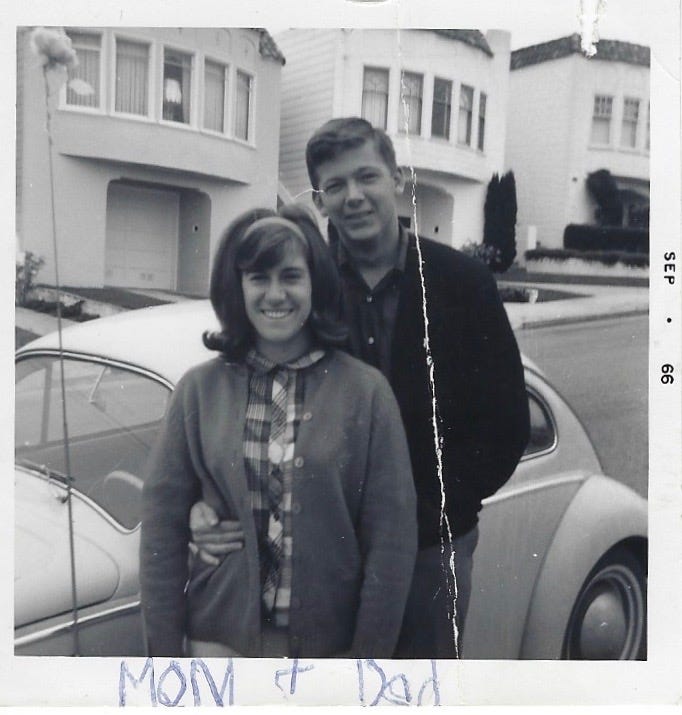
My mom closed her eyes. I thought she’d fallen asleep. I was about to send my siblings a text update when she brusquely interrupted the sudden quiet. “Everything’s going to be OK,” she blurted more to herself than to me. Just then, a deep rumbling sound underscored the familiar buzz of the unit. “Ha! You hear that?” she said smugly. “There’s my train again. That’s dad reassuring me.”
I listened for a second, hoping that this time it really was a train. That maybe this time I might find something to reassure me, too. Something to make me feel like everything was going to be OK. But it was just the janitor and buffer again adding a temporary shine to an otherwise frail and miserable place.
Lovely Tom. Hard to read, just a little too close to home.
When my mom stopped talking, the only way she communicated was by crying. And she cried all the time. I could see the terror in her eyes, the pleading, and I knew that she knew - she was never coming home, never getting better, never going to even sit up in bed again. I whispered lies in her ear, that she was going to see Dad again, that he was waiting for her, because lies were the only things left to comfort her. Then when she stopped even crying and just stared at the ceiling all day, I hoped the meds were melting what was left of her mind and that she didn’t feel anything at all.
I hope this ordeal ends quickly and peacefully my friend. You both deserve it.
Beautiful piece. I just got back from my annual physical exam. I provided my birthdate four times. I knew it well and am marvelling now at what it means when you lose that bit of information. My mom had dementia when she died just two Septembers ago. My dad had Alzimers; so I wonder what's in store for me. // I knew I needed a procedure, but it's name eluded me, which I admitted to my doctor. I said, "you know... the ole camera up the butt." He chortled and helpfully provided,"Colonoscopy." So now I'm mulling, is it starting now? Ambulance men is to EMTs as camera up the butt is to colonoscopy.
It's sad to see our parents loose their sharpness and seemingly become children again; thanks for recording it so well.