
Twosome
Bonding with my dead father over microtones and irregular time signatures

My dad died just over three years ago. Since that day, I’ve experienced everything through a new lens. One that makes my own demise feel closer. A bit clearer. One that finds me more curious about my family’s health history. About my onset of heart palpitations. About specific details of stories my dad would sometimes tell. Stories I often disregarded because I had heard them so many times.
My reflections since that day have also underlined things that I, as a son, could have done differently. Things that might have made my relationship with my dad more father-son-like. Had I only been more open-minded, less self-centered and proud, maybe we would have laughed more. Known more about each other’s lives. Shared feelings and anecdotes to willingly give glimpses into who we genuinely were as people.
But I didn’t do these things. None of them. I never stopped silently putting the impetus on him to make the first move. Never expressed my wishes for us, my hopes. Never humbled myself to the healing power of time. So, as years went by, the psychic distance between us increased. And when he died, our disunion, though amicable, was what remained.
There are so many lingering could haves. I could have done this, could have done that. Exploring them is an ever-present way for me to feed my guilt for having done little to improve our connection while he was still alive. Could haves guarantee heartache. But sometimes it feels good to feel bad.
But I don’t want to live with regret. I don’t want the remainder of my days to be themed by remorse. So I’ve worked to accept the choices I made back then, and given myself grace for my headstrong decisions.
Now, I honor my father, and myself for that matter, by using our relationship as a template for what not to do with people I aim to love. These days, I reach out more. Share my feelings more. Make known my intentions more. These are not attributes I learned directly from my dad, but he damn sure played an integral role in teaching me the value of such human intimacies.
A couple weeks back, while checking out some new music, I had an overwhelming desire to sit with my father. To sit and listen together. I had no context for doing anything like this with him, but still I knew it was the right thing to do. It needed to happen.
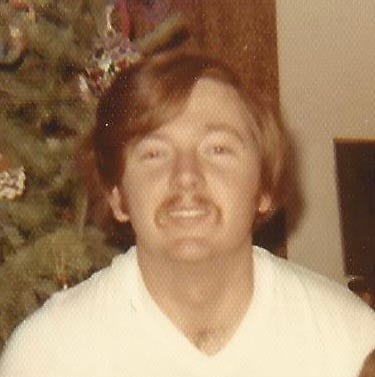
So I made myself a cup of coffee, pulled out one of his photos—one from the month I was born, from back when he was still a young parent, when our differences hadn’t yet become hindrances—and opened Apple Music.
“Check this out,” I said. “You ever heard of math rock?”
The Canadian duo, Angine de Poitrine, went viral earlier this year (and their name means “angina/strangling of the chest”). But before they filled my social media feeds, I caught wind of them on a private Facebook music group where someone posted a link and wrote, “I have no idea where they’re from. A two-piece band and some rather excellent jazzy stuff presented in an unusual way. Anyone else heard of them?”
I clicked and was unimpressed. Days later, a friend who’s not even on social media texted about the same band. “Really hard to listen to,” I wrote back. “A musical mess.”
Within days, I couldn’t go online without getting inundated by Angine de Poitrine’s “math rock.” That’s right, math rock. It’s characterized by complex, unpredictable time signatures, angular melodies, polyrhythms, and use of loop pedals. Details that make sounds, but not necessarily the sort to tap a foot to. Though there are melodies, their inconsistencies make them really hard to settle into. Like listening to a string of endless crises. Ears concurrently captivated and traumatized.
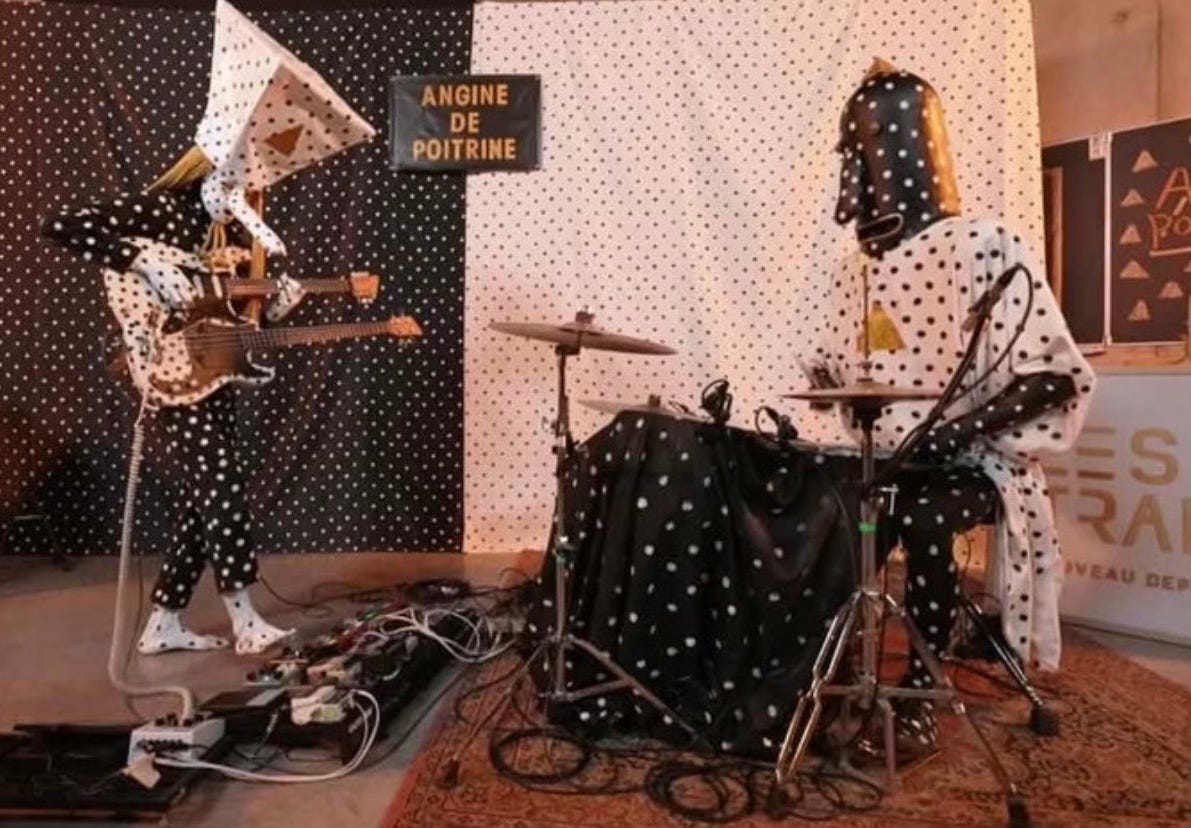
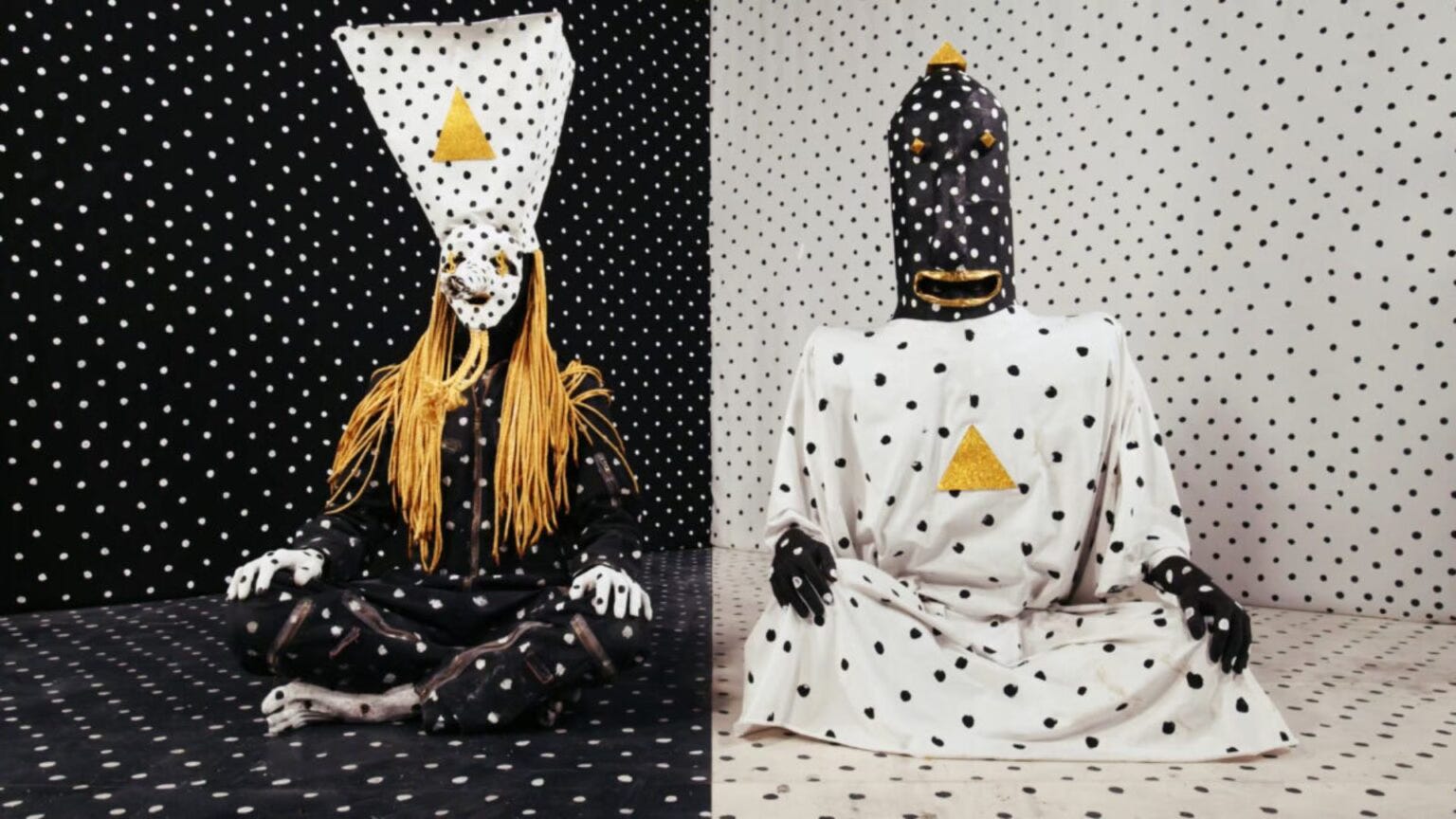
In Angine de Poitrine’s case, the unusual combination of sounds is made more bewitching by their absurdist costumes and atypical instruments. They wear black and white polka-dotted attire and over-sized papier-mâché masks.
Between songs, the anonymous twosome performs ritualistic gestures (their hands in the shape of a triangle, for one, waving outstretched arms in unison, another), and never speak coherently. Their “language” consists of distorted vocalizations of something-sounding gibberish.
As for the members, Klek plays drums, expertly maintaining oddly-stamped tempos and starts, while Khn plays a double-necked hybrid guitar/bass where both instruments have additional microtonal frets which glow phosphorescent to help compensate for Khn’s inability to fully see through the mask (the eye holes are impeded by bejeweled dollar signs).
Khn also nimbly works a loop station with bare feet. One internet meme jokes that there are actually three people in the band: Klek, Khn, and Khn’s deft toes that work like fast fingers over the various knobs.
The band came at me sideways and I initially loathed them. But the more my algorithm fed them to me, the more I learned precisely what they were doing. And what they were doing fascinated me. Their rule-breaking choices appealed to my artistic nature, and my hate quickly turned to an irrational love. I suddenly wanted everyone I knew to hear them and feel the glorious agitation that I was also feeling.
Angine de Poitrine sidelined my previous obsession (IDLES) and I was soon listening to them exclusively. Filling my day with their two albums, Vol. 1 and Vol. II, live excerpts from past shows, and the KEXP performance that introduced the Montreal virtuosos to the world at large and made them abruptly famous.
Now, a couple months later, I am still not yet convinced that Angine de Poitrine’s music isn’t some sort of spell. Like maybe it’s a portal to a different dimension or plane of being. Perhaps somewhere in that microtonal math is a subconscious voice, a commanding message, meant to influence my next move. But whatever. Because I don’t care. Given the state of the world, a transformative artistic wormhole is pretty doggone appealing right now.
After a second listen of “Fabienk,” but a live version this time, I read the look on my dad’s face. Pretty sure he didn’t like it, nor any of Angine’s other stuff I played for him. Which wasn’t a surprise, since his record collection had always been as vanilla as it comes. Manfred Mann, Herb Alpert, Roger Williams, and more recently, anything by Cher.
“So, what do you think?” I asked him.
He squinted and smiled—gave me a look like his answer to my question should be obvious. Then he did what he always did while deep in thought and ran his fingers through his perfect head of auburn hair and closed his eyes for an extended blink. Then he reopened his eyes, laughed a little, and cleared his throat.
“I think you and I have very different tastes in music,” he said.
“So diplomatic,” I said, cracking up.
I took my last sip of coffee and picked up his photo. Bright it closer to my face.
“Let’s do this again,” I said.
“I’d like that,” he said. “Maybe I’ll bring something next time.”
“Cool,” I said.
Then I tucked his photo away.
*
There is no poetry in stagnation. No ingenuity in sameness. When my dad died, I found a new way to breathe. And frankly, I believe he did, too.
It took death to open my eyes to what could be with my dad. And since he’s been gone, I have felt surrounded by more love than ever. I assume it’s always been there, but I can see it now. Feel it now.
Such is the beauty, the magic, the necessity of our most transformative moments. Tragic or joyous, cadenced or arrhythmic, we need these moments in order to evolve.
To become better at being alive.
A refreshing take on how to navigate difficult grief. It’s relatable and honest. I enjoy the visuals that come to mind and a win for math rock.
I listened to music only a couple of times with my, also difficult, Dad. Most notably, the day John Lennon died, he went out and bought Double Fantasy. It felt so profound listening to it together.
Thanks for reminding me of this memory.