
My Teaching Style
During a recent job interview, someone asked me a question that reminded me exactly what I am meant to do

A few weeks ago I interviewed for a senior level job as a corporate educator. I wasn’t actively looking for employment, but an opportunity popped up that seemed written specifically for my unique professional background. The hiring company was one I fully believe in—its values and ethics and worldview aligned strongly with my own. It was a company about which I’ve often said that if I was going to work for someone again, it could only be them.
I wrote my first resume in more than ten years and got a quick call back. “We’d like you to put on a 20-minute virtual training,” they said. And considering the nature of the position, I had expected as much.
I then spent the next week in prep mode. Which was a fantastic escape from the reality of my moment—I was currently face-deep, once again, in the throes of helping my mom after she sustained a series of three more falls, the last of which put her in the hospital for a week, then rehab for three more, then a brief stint home where she prepared for an unexpected yet necessary move into a community that offered a higher level of care.
I’ve always loved interviews. I especially enjoy when I’m asked unexpected questions. My preparation is easy—I simply commit to answering honestly. I don’t want to win a position after having sugared up my qualifications. I most appreciate when questions eschew the generic. When I am forced to be vulnerable, to thoughtfully deliver something authentic. Something that clues people in to who I really am or who I aspire to be. I don’t mind my truth. I don’t mind the spotlight.
This interview did not disappoint. I answered questions posed by the panel of three, each of whom offered smart questions for me to field. The group’s dynamic settled quickly and the interview, straying from the norm, morphed instead into a vibrant conversation. I remember thinking, “Let’s go! I could totally work with these people!”
One question they threw at me was a biggie in disguise. My favorite sort. They asked, “How would you describe your teaching style?” It should be known that I, at times, am prone to verbosity. Or maybe it’s just that I’m well-versed at explaining the same thing in multiple ways (I was a middle school teacher, so this tendency was born from necessity). I could have easily taken this straightforward question and wildly complicated it. But instead I responded as if I’d known it was coming.
My words, succinct and well-spoken, flowed naturally. “My style,” I said, “is multi-faceted.” I then summarized the four components I’ve historically adhered to to make me an unforgettable educator. They are: 1) Follow the scaffold, 2) Tell stories, 3) Keep it simple, 4) Wear a funny hat.
First, I follow the scaffold. I was formally trained on how to effectively teach a classroom of young learners. And though my audience has changed from kids to adults, I still deploy the same progression of tactics including: I tap into what they already know about the topic, I identify context for the content (the “why”), I teach it, lead it, then I send them off to practice on their own. Eventually we circle back to revisit things, which helps keep momentum while harvesting community around the new material.
Second, I tell stories—true stories from various disciplines. No matter how good my content is, or how well versed I am in it, if I don’t somehow humanize it with a a few curious and well-told narratives, I compromise the overall efficacy my content’s staying power. I believe that every possible training topic is anchored in some way to a top-level human concept. That concept is universally (or at least widely) understood and somehow experienced, albeit uniquely, by everyone in attendance. I want to tie us together using this concept as our common ground. It’s not uncommon for me to tell a disparately-themed story from hiking or running to illustrate something seemingly unrelated like customer service or sales or retail excellence or human connection or whatever. I believe that every story is somehow connected to every other story. I just have to get extra creative to figure out the threads that link them together.
Third, I keep things simple. And the way I see it, to simplify is to focus. I once had a professional mentor who told me that the most effective staff meetup dedicates 90% of its time proving that people matter, and 10% of the time discussing whatever business items need attention. Of course this 90/10 rule can’t always be how things shake out, but I can try. Simplicity in material, an obvious focus on my reasons for delivering it, and clarity with what I’m asking will keep folks engaged. My simple focus keeps me on point and proves I respect my learners.
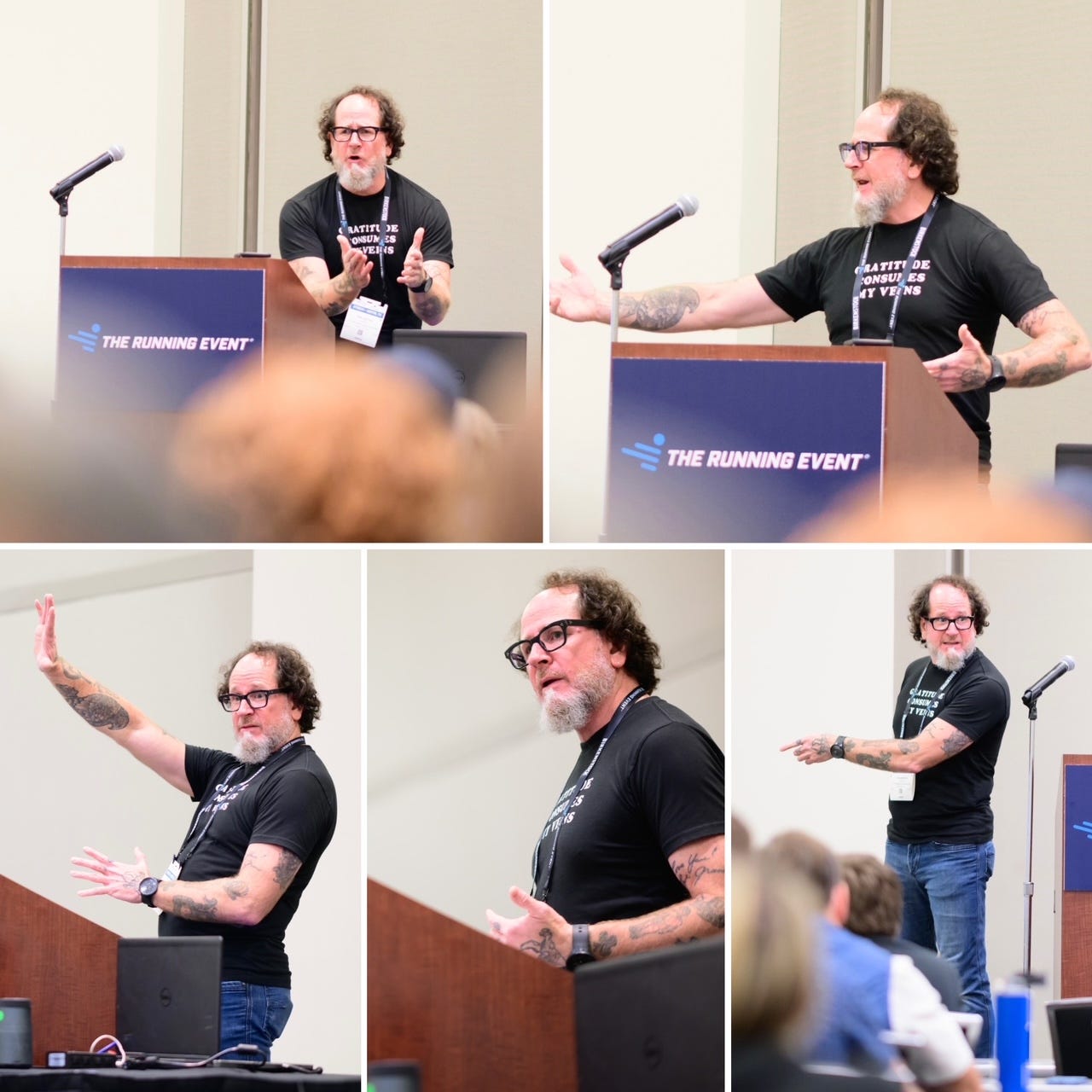
And finally, I wear a funny hat. When I taught children, this was often a literal reality. I would wear a relevant costume item and create a fun association with content. If we were doing a lesson on WWII, I might pick up a steel pot helmet from the Army Navy store and rock it for our session. One time I used a class on the American frontier as my excuse to buy a leather jacket with fringe (TBH, I might have bought it anyhow). With my adult students, “a funny hat” is most always metaphorical. My goal is always to figure out a way to bring something unexpected into the lesson that might make folks a little uncomfortable. Purposeful vulnerability increases retention.
These four principles have proven to be invaluable to my career as an educator. They surely encompass what makes up my style, but I offered them to the panel only as guidelines. Because like any good recipe, merely following the steps doesn’t guarantee an excellent outcome. In fact, simply executing a checklist for any process including people is never enough. There’s tremendous value in the invisibles, too. My humility, my care, my energy—it all matters, too.
“My teaching style,” I told the interviewers, “reflects who I am as much as it defines how I present.” My preparation, my willingness to practice and refine, my attention to the smallest details, and my crucial revisions that eliminate unnecessaries all represent how I live my life. Which reminded me, on the fly, of a different interview I had decades ago before accepting my very first teaching position. I shared something a veteran educator told me. Her words stuck. So much that some thirty years later I relayed the pivotal anecdote to the hiring panel.
“You can’t teach that which you are not.”
For an extra moment nobody said a word. And right then I knew it would be just fine if this interview didn’t get me anywhere. I had done what I do best—I taught these folks a little something. And if that’s all this moment was going to amount to, well, I had served my purpose.
How does this offer/opportunity fit in with the 100 day AT trek coming up?
This is brilliantly you! Such thoughtful and positively energetic
!